











Blogs
Biologicals and Microbials in Agriculture: Understanding the Science and the Data Behind Them
The constantly growing demand for food, increasing resistance to chemical methods of crop preservation, and the need to maintain soil health while sustaining productivity are some of the major current challenges in agriculture. These pressures have renewed the interest in learning how biologicals can be developed and shaped to protect and improve crops.
Understanding biologicals in the agricultural context
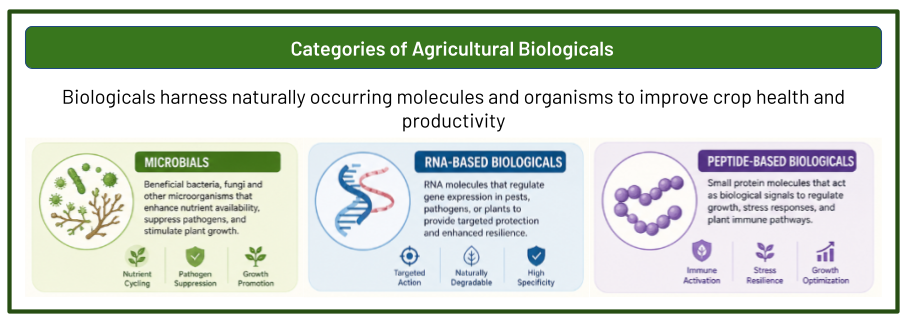
Biologicals are products derived from living organisms or biological molecules that can influence plant growth, crop protection, or soil health. They differ from traditional agrochemicals in the fact that they rely on biological processes rather than synthetic chemical reactions. In agriculture, biologicals often fall into several categories that include microbial agents, nucleic acid based technologies such as RNA, and biologically active peptides.
Biological molecules have long been used in medicine and biotechnology. Biologics, in the broader life sciences sense, are produced by living systems such as microorganisms or cultured cells and can include proteins, nucleic acids, and other complex biomolecules. Their activity depends on precise molecular interactions that influence biological pathways or immune responses. The same principle also holds true for when biological molecules are applied to agricultural systems, where they interact with plant physiology or microbial ecosystems.
Agricultural biologicals operate through modes of action (MoAs) that are more closely aligned with natural biological processes than with conventional chemical methods. As a result, they often offer targeted activity and reduced environmental impact. However, they also introduce scientific complexity because their effectiveness depends on living systems that vary across environments and often function through novel modes of action. While novel MoAs are prized, deconvoluting and then leveraging this to create robust and effective Biological products is a scientific challenge.
Microbial solutions and the crop microbiome
Microbial products are some of the most widely studied agricultural biologicals, and encompass beneficial bacteria, fungi, or other microorganisms that support plant health. Some improve nutrient availability through nitrogen fixation or phosphorus solubilization, while others suppress plant pathogens or stimulate plant immune responses.
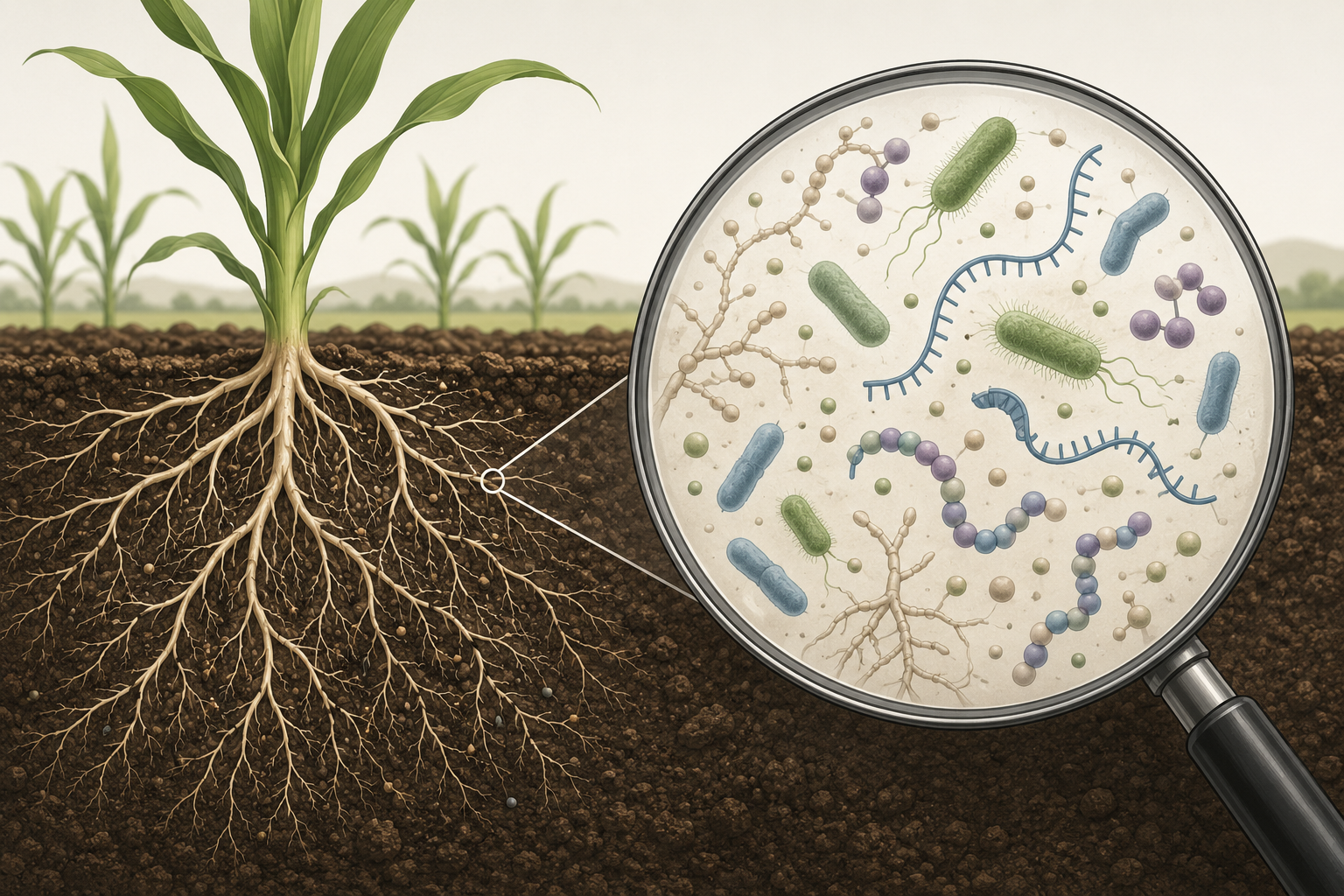
Soil and plant microbiomes contain vast and complex microbial communities, with billions of microorganisms in a single gram of soil. Within this system, beneficial microbes influence plant growth through signaling, nutrient exchange, and pathogen suppression.
Identifying microbes that perform these functions consistently and determining the mechanism of their action requires large scale microbial community analysis. Metagenomics and metatranscriptomics allow researchers to study microbes directly from environmental samples and identify active genes and pathways that contribute to crop resilience and productivity.
RNA based biologicals and gene regulation
RNA technologies represent a growing area in agricultural biological development. RNA molecules regulate gene expression within living cells, and introducing specific RNA sequences can influence genes in pests, pathogens, or plants.
RNA interference relies on short RNA molecules that silence selected genes. When these molecules enter a pest or pathogen, they interrupt the production of proteins essential for survival or reproduction. This enables crop protection strategies that target specific organisms rather than relying on broad chemical activity.
RNA based approaches also address the increasing environmental and regulatory problem associated with conventional pesticides. RNA molecules degrade naturally and act on defined genetic targets. However, developing these technologies also requires detailed genomic information and careful validation to confirm target specificity.
Peptides and biological signaling
Peptides represent another group of biological molecules with agricultural potential. In plants and microbes, peptides act as signaling molecules that regulate growth, stress responses, and defense pathways.
Researchers are investigating synthetic and naturally derived peptides that reproduce these biological signals. Some peptides activate plant immune responses and strengthen defense against pathogens. Others influence growth pathways that help plants maintain productivity under stress.
The development of peptide based biologicals requires detailed knowledge of plant signaling networks and protein interactions. However, small changes in peptide structure can affect biological activity, highlighting the importance of reliable computational analysis and validated molecular models for the discovery and design.
Data challenges in biological agriculture
Biologicals, particularly microbials and biomolecules like RNA, present data challenges that differ significantly from those of conventional agrochemicals. Their performance depends on variable factors such as soil composition, microbial diversity, and crop genotype.
Beyond environmental flux, RNA-based solutions require high precision in design to ensure strong phenotypes and a broader spectrum of activity across multiple pests. Furthermore, identifying candidates with minimal impact on non-target organisms (NTOs) is critical to ensuring their environmental safety profile remains superior to that of traditional synthetics.
Therefore, research on biologicals for agricultural applications involves the generation of complex datasets, and entails genomic sequencing, laboratory studies, greenhouse experiments, and field trials. The data must also be integrated to connect molecular activity with crop performance.
Microbial profiling is one example that illustrates this complexity. A single metagenomic study can generate millions of sequencing reads that require mapping to reference databases, functional gene annotation, and ecological analysis. Converting such data into useful insight requires well designed analytical pipelines and standardized data frameworks.
The role of advanced bioinformatics
The ability to interpret complex biological data is an essential part of developing agricultural biologicals. Understanding the numerous molecular interactions that occur within the dynamic biological environments also requires bioinformatics systems capable of processing large sequencing datasets and linking molecular insights to agronomic outcomes.
In the microbials case, bioinformatics workflows allow researchers to analyze metagenomic and metatranscriptomic datasets, identify microbial taxa, and map functional genes associated with nutrient cycling, pathogen suppression, and plant growth. These approaches provide a detailed view of microbial communities at both the species and functional levels, revealing active metabolic pathways and shifts in microbial populations across environmental samples.
As sequencing studies expand to include large sample cohorts, scalable computational infrastructure becomes essential for maintaining consistency, reproducibility, and efficient analysis.
Biologicals through integrated data platforms and data-driven research
Scientific Complexity in Developing Agricultural Biologicals
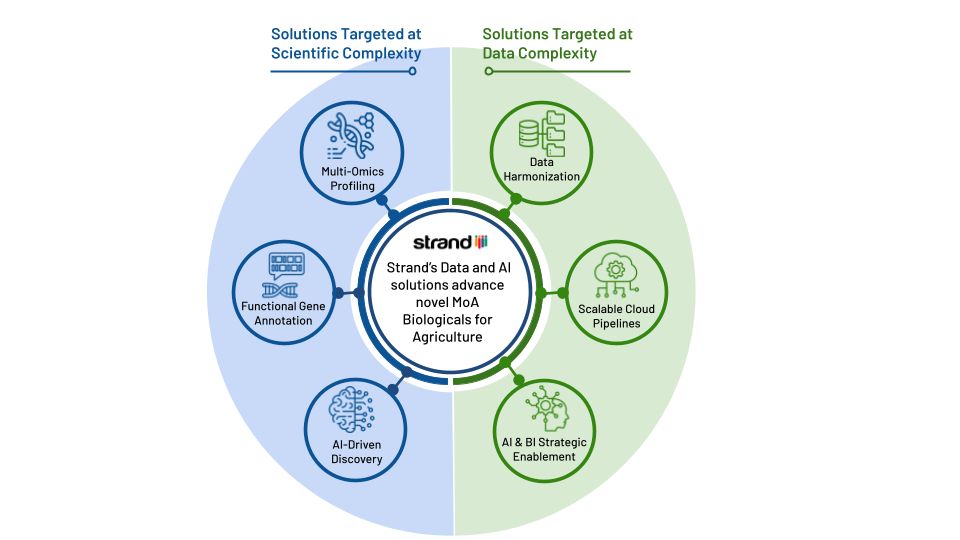
For organizations developing biological products, the primary challenge is scientific complexity. Understanding how microbial strains, RNA molecules, or peptides influence crop health and performance requires advanced bioinformatics analysis and omics-driven approaches. Agricultural research increasingly relies on multi-omics datasets to decode interactions within microbial communities and their functional impact on plant systems.
However, this research is further complicated by the variability of biological systems across environments, climates, and soil conditions. Unlike synthetic chemicals, biologicals such as microbes, RNA molecules, and peptides function within complex biological environments and depend on numerous ecological interactions that influence consistent field performance.
In parallel, metagenomic and sequencing studies generate massive, highly diverse datasets that require sensitive analytical pipelines, functional gene annotation, and precise genomic characterization to identify beneficial organisms, understand biological mechanisms, and minimize off-target effects. Sequencing analysis also plays a critical role in target discovery, and the design and characterization of biomolecules by enabling precise identification and validation of genes, pathways, and sequence-level variations associated with desired biological functions.
Strand Life Sciences addresses these challenges through integrated bioinformatics platforms designed for large-scale biological research. Strand’s metagenomics, metatranscriptomics, and 16S rRNA profiling workflows enable detailed characterization of microbial communities across diverse sample types. Researchers can identify microbial species, analyze diversity patterns, and annotate functional genes within complex environmental microbiomes, supporting the identification of microbial candidates and biological molecules with strong agricultural potential.
As research scales across larger cohorts and distributed teams, maintaining reproducibility across analytical workflows becomes an additional challenge. Strand addresses these needs through standardized and scalable bioinformatics frameworks that are AI-enabled and cloud-supported.
These frameworks integrate high-sensitivity microbial detection, AI-driven interpretation, functional annotation, high-throughput sequencing analysis, and structured knowledge generation. Together, these capabilities help convert complex biological data into actionable scientific insights.
Continuous improvements in microbial detection pipelines have further increased analytical sensitivity. This enables the identification of low-abundance organisms within complex biological samples. In parallel, advanced genomics software development enhances both the depth and speed of biological insights.
Data Complexity in Agricultural R&D
The second major challenge organizations must address is data complexity. Agricultural R&D generates heterogeneous datasets spanning molecular profiles, laboratory experiments, greenhouse studies, and field trials. Integrating and contextualizing these diverse data streams is essential to translate molecular findings into real-world agricultural outcomes.
Strand supports this through robust data harmonization and integration frameworks. By applying standardized ontologies and controlled vocabularies, Strand enables unification of data across multiple input streams—lab, greenhouse, and field environments. These systems facilitate seamless connections between molecular insights, experimental observations, and downstream product development decisions.
Strand also emphasizes data democratization, ensuring that curated and harmonized datasets are accessible not only to bioinformatics specialists but also to researchers, agronomists, and decision-makers. Automation of computational workflows further streamlines data processing and reduces operational complexity across research programs.
Through this combined focus on scientific and data complexity, Strand enables agricultural biotechnology teams to transform fragmented, large-scale biological datasets into structured, actionable knowledge—accelerating discovery, improving experimental design, and supporting the development of next-generation biological products.
Click here to learn more about Strand's agricultural technology capabilities.



Let's Connect
Let's Connect

download the case study.