








Foundation
Models for Multi-Omics Discovery
Foundation Models for Multi-Omics Discovery
Foundation models are reshaping how biological data can be analyzed, interpreted, and translated into insights across the drug discovery lifecycle. At Strand, we work with foundation models across genomics, transcriptomics, proteomics, molecular data, and single-cell biology — adapting them to disease-specific and research-specific applications.
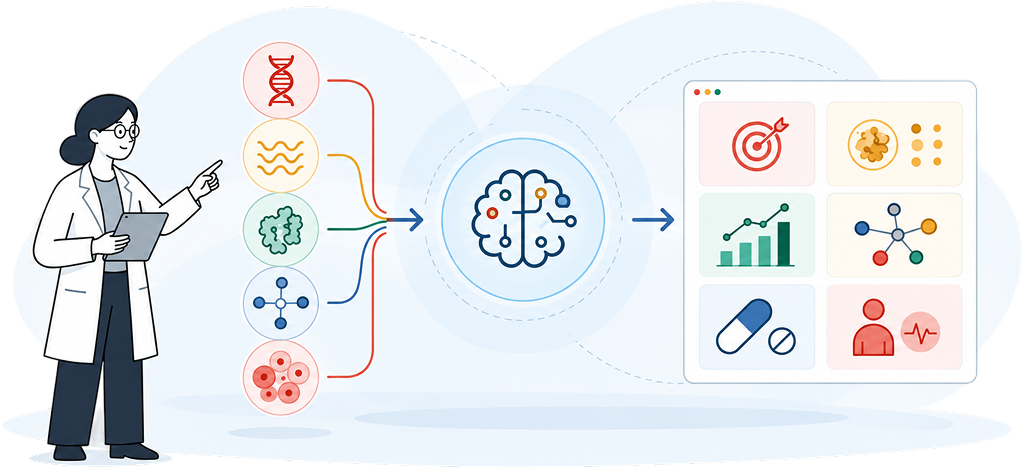
Adapting Foundation
Models for Drug
Discovery
Foundation Models in Pharma
Genomic & Molecular Analysis
Predictive modelling
Patient & clinical Insights
Application:
Identify disease mechanisms, discover and prioritize therapeutic targets, and investigate molecular pathways using genomic, transcriptomic, proteomic, and single-cell data. Foundation models can support variant interpretation and pathogenicity prediction, functional annotation, disease-associated pathway identification, cell-type characterization, and in-silico gene perturbation to assess potential therapeutic targets.
Capabilities
Foundation Models:
Evo 2, AlphaGenome, DNABERT-2, Nucleotide Transformer, ESM-2, scGPT, scBERT, scFoundation, UCE, STATE, STACK
DISCOVERY
Target identification
Application:
Identify disease mechanisms, discover and prioritize therapeutic targets, and investigate molecular pathways using genomic, transcriptomic, proteomic, and single-cell data. Foundation models can support variant interpretation and pathogenicity prediction, functional annotation, disease-associated pathway identification, cell-type characterization, and in-silico gene perturbation to assess potential therapeutic targets.
Capabilities
Foundation Models:
Evo 2, AlphaGenome, DNABERT-2, Nucleotide Transformer, ESM-2, scGPT, scBERT, scFoundation, UCE, STATE, STACK
Application:
Evaluate drugs–target interactions, mechanisms of action, and potential therapeutic efficacy and toxicity using molecular, proteomic, and cellular data. Foundation models can support protein–ligand binding prediction, drug-response prediction, genetic and chemical perturbation modelling, off-target effect assessment, and early toxicity prediction.
Capabilities
Foundation Models:
ESM-2, Boltz-2, MolFormer, ChemBERTa, STATE, STACK, scGPT, scBERT, scFoundation, UCE
PRECLINICAL
Efficacy & safety
Application:
Evaluate drugs–target interactions, mechanisms of action, and potential therapeutic efficacy and toxicity using molecular, proteomic, and cellular data. Foundation models can support protein–ligand binding prediction, drug-response prediction, genetic and chemical perturbation modelling, off-target effect assessment, and early toxicity prediction.
Capabilities
Foundation Models:
ESM-2, Boltz-2, MolFormer, ChemBERTa, STATE, STACK, scGPT, scBERT, scFoundation, UCE
Application:
Evaluate initial therapeutic activity in humans, identify predictive biomarkers, and characterize variability in treatment response using genomic, transcriptomic, and proteomic data. Foundation models can support patient stratification, responder versus non-responder prediction, biomarker discovery, pharmacokinetic/pharmacodynamic (PK/PD) modelling, and dose-response assessment.
Capabilities
Foundation Models:
Bulkformer, COMPASS, DNABERT-2, Nucleotide Transformer, MolFormer, ChemBERTa
EARLY CLINICAL
Human response
Application:
Evaluate initial therapeutic activity in humans, identify predictive biomarkers, and characterize variability in treatment response using genomic, transcriptomic, and proteomic data. Foundation models can support patient stratification, responder versus non-responder prediction, biomarker discovery, pharmacokinetic/pharmacodynamic (PK/PD) modelling, and dose-response assessment.
Capabilities
Foundation Models:
Bulkformer, COMPASS, DNABERT-2, Nucleotide Transformer, MolFormer, ChemBERTa
Application:
Assess therapeutic efficacy across larger patient populations, characterize treatment-response heterogeneity, and monitor disease progression and therapeutic resistance using molecular and cellular profiles. Foundation models can support treatment-response prediction, patient subgroup analysis, longitudinal biomarker monitoring, resistance mechanism identification, and disease progression modelling.
Capabilities
Foundation Models:
Bulkformer, COMPASS, DNABERT-2, Nucleotide Transformer, STATE, STACK
LATE CLINICAL
Efficacy & monitoring
Application:
Assess therapeutic efficacy across larger patient populations, characterize treatment-response heterogeneity, and monitor disease progression and therapeutic resistance using molecular and cellular profiles. Foundation models can support treatment-response prediction, patient subgroup analysis, longitudinal biomarker monitoring, resistance mechanism identification, and disease progression modelling.
Capabilities
Foundation Models:
Bulkformer, COMPASS, DNABERT-2, Nucleotide Transformer, STATE, STACK
Resources
Resources
Poster
