










AI Guardrails at Strand
AI Guardrails at Strand
At Strand, we develop and deploy AI systems within structured governance frameworks designed to ensure safe, responsible, and compliant use of AI in regulated genomics and pharmaceutical environments.
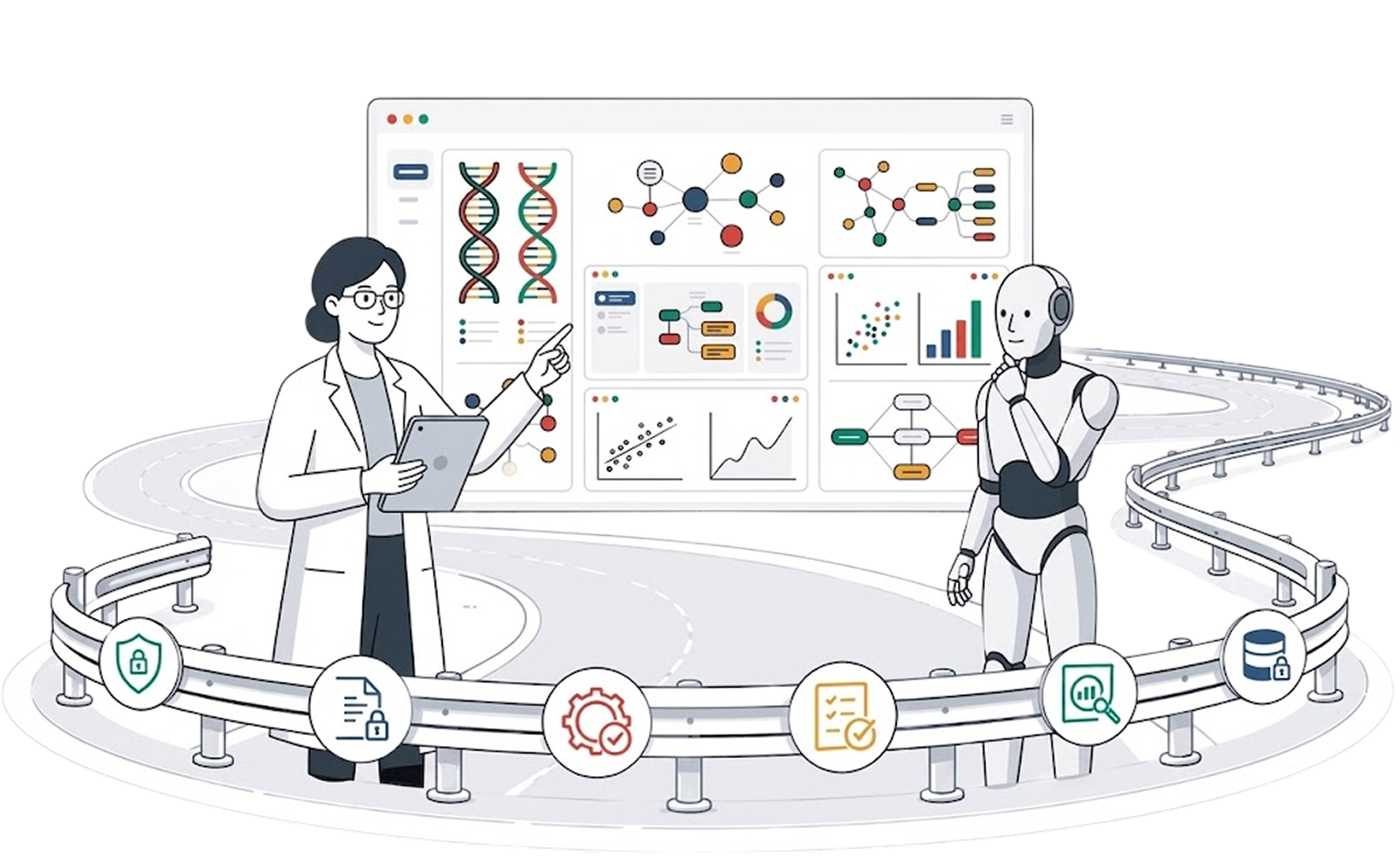
Responsible AI
Governance at

Responsible AI
Governance
at
This section outlines Strand’s approach to AI guardrails and responsible AI enablement.
Here, we aim to:
- Highlight our approaches to auditability, oversight, and human-in-the-loop review processes.
- Capture the key AI governance layers relevant to Strand’s research informatics and translational genomics initiatives.
- Reflect on Strand’s evolving experience across AI-enabled workflows, governance controls, auditability, and review processes.
AUDITABILITY
Ensuring transparency and accountability in AI processes.
OVERSIGHT
Implementing robust monitoring and control mechanisms.
HUMAN-IN-THE-
LOOP REVIEW
Integrating human judgment into AI decision-making.
AI GOVERNANCE
LAYERS
Establishing clear structures for AI management.
EVOLVING
EXPERIENCE
Adapting and improving AI workflows over time.
Core
Governance Layers
Core Governance Layers
As Strand’s AI capabilities and customer engagements continue to expand, this space will be continuously updated to incorporate new operational requirements, implementation patterns, and best practices supporting secure and reliable AI adoption at scale.
What it covers
Who can access the system and what data they can see.
Key controls
Genomic data tiered access controls (individual level vs aggregate level, guardrails to minimize re-identification risk with aggregate data) as well as for emergency scenarios (break-glass protocols such as subject safety signal, debugging for regulatory submission). AI guardrails can help ensure permissions are minimum needed, privileges are temporary and prevent any out-of-scope inference. AI can generate reports for Post-hoc audits).
IDENTITY & ACCESS
What it covers
Who can access the system and what data they can see.
Key controls
Genomic data tiered access controls (individual level vs aggregate level, guardrails to minimize re-identification risk with aggregate data) as well as for emergency scenarios (break-glass protocols such as subject safety signal, debugging for regulatory submission). AI guardrails can help ensure permissions are minimum needed, privileges are temporary and prevent any out-of-scope inference. AI can generate reports for Post-hoc audits).
What it covers
Securing what enters the model.
Key controls
Prompt injection defenses, separation of trusted system instructions from untrusted content, jailbreak classifiers, treating retrieved docs and tool outputs as untrusted, upstream PHI/PII de-identification, data consent scope validation before AI ingestion.
INPUT
What it covers
Securing what enters the model.
Key controls
Prompt injection defenses, separation of trusted system instructions from untrusted content, jailbreak classifiers, treating retrieved docs and tool outputs as untrusted, upstream PHI/PII de-identification, data consent scope validation before AI ingestion.
What it covers
Preventing catastrophic agent behavior.
Key controls
Human-in-the-loop approvals for destructive ops, allowlisted commands, blast-radius limits on writes, sandboxed execution, no production credentials by default, full reversibility via git/snapshots.
ACTION
What it covers
Preventing catastrophic agent behavior.
Key controls
Human-in-the-loop approvals for destructive ops, allowlisted commands, blast-radius limits on writes, sandboxed execution, no production credentials by default, full reversibility via git/snapshots.
What it covers
Ensuring outputs are accurate and safe to release.
Key controls
Mandatory human review for clinical/customer-facing output, schema and citation validation, model uncertainty quantification and confidence thresholds, PHI scanning on outbound text, deterministic validators against source data.
OUTPUT
What it covers
Ensuring outputs are accurate and safe to release.
Key controls
Mandatory human review for clinical/customer-facing output, schema and citation validation, model uncertainty quantification and confidence thresholds, PHI scanning on outbound text, deterministic validators against source data.
What it covers
Knowing what the system did and proving it.
Key controls
Immutable logs of prompts, tool calls, retrievals, and outputs with user identity and model version; HIPAA/GxP/SOC 2 audit trails; drift monitoring.
OBSERVABILITY & AUDIT
What it covers
Knowing what the system did and proving it.
Key controls
Immutable logs of prompts, tool calls, retrievals, and outputs with user identity and model version; HIPAA/GxP/SOC 2 audit trails; drift monitoring.
What it covers
How different categories of data are governed, isolated, and protected when used within AI-enabled workflows and external AI platforms.
Key controls
Data classification–aware AI usage policies, enterprise AI environments with contractual guarantees around data privacy, controlled handling of proprietary and restricted datasets, review of vendor privacy/licensing terms, and use of internally hosted or offline AI models for sensitive workflows. Guardrails help ensure confidential data remains isolated within approved organizational environments and is not exposed through external training pipelines, cross-tenant access, or unintended downstream reuse.
SEPARATION OF PUBLIC, PROPRIETARY, AND RESTRICTED DATA
What it covers
How different categories of data are governed, isolated, and protected when used within AI-enabled workflows and external AI platforms.
Key controls
Data classification–aware AI usage policies, enterprise AI environments with contractual guarantees around data privacy, controlled handling of proprietary and restricted datasets, review of vendor privacy/licensing terms, and use of internally hosted or offline AI models for sensitive workflows. Guardrails help ensure confidential data remains isolated within approved organizational environments and is not exposed through external training pipelines, cross-tenant access, or unintended downstream reuse.
Let’s Connect
Let's Connect

download the case study.